INNOVATIVE PROJECTS PLATFORM
Hydrogen
Hydrogen can be produced by various process technologies. Hydrogen can be obtained from natural gas through a steam reforming process or a methane pyrolysis process; produced by splitting water into hydrogen and oxygen via electrolysis or via gasification process, by converting solid fuel (coal or woody biomass) to hydrogen. Hydrogen can also by produced through anaerobic digestion, converting wet biomass to hydrogen. Hydrogen can be utilised directly as fuel or, depending on the application, blended with natural gas.
Hydrogen production from RES-based electricity in power-to-gas facilities or from other fuels in combination with CCS contributes to the decarbonisation of the energy system.
REN
H2RENGRID - Transport Network
The project is intended to develop the necessary repurposing of the national transmission network (RNTG) for blending of hydrogen into the natural gas streams. According to the current national legislation and regulation, the network has to be able to receive gas mixtures of hydrogen and natural gas with hydrogen content of 10% v/v until 2030. For the national transmission network (RNTG), the investments are split into pipelines and inspection programs, control systems, AGI (above ground installations) equipment and analysers and metering equipment.
Contact: Pedro.Morais@rengasodutos.pt
Snam, TAG, Eustream, NET4GAS, OGE
SunsHyne Corridor
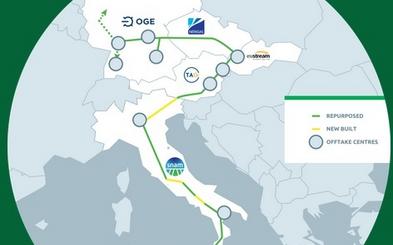
SunsHyne Corridor is a strategic infrastructure initiative that will enable the transport of green hydrogen, mainly via repurposed pipelines, from production areas in North Africa to demand centres in Central Europe. Five leading European gas transmission system operators - Snam, TAG, Eustream, NET4GAS and OGE - are working together to implement till 2030 this important segment of 3400 km length of the European Hydrogen Backbone. The SunsHyne Corridor enables supply to high-demand centres in Central Europe all along the route.
Contact: karin.stehlik@net4gas.cz
Gas Networks Ireland
Hydrogen Integration
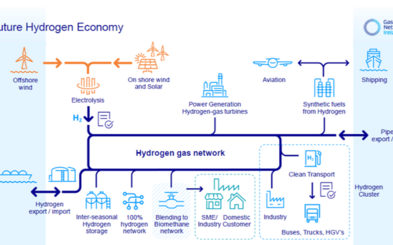
GNI is preparing for the integration of hydrogen into the existing natural gas system through the development of dedicated hydrogen networks at strategic clusters and the preparation of the existing network to accept blends of hydrogen. The Irish national hydrogen strategy published in July 2023 identifies that although blending of hydrogen and biomethane is unlikely to be an enduring end use for hydrogen produced in Ireland it could provide a route to market for the first phase of hydrogen production projects as well as recognising that hydrogen blends will enter Ireland through the interconnectors to Great Britain if the UK begin to blend into their natural gas network.
GTSOU, EUSTREAM, NET4GAS, OGE
The Central European Hydrogen Corridor (CEHC)
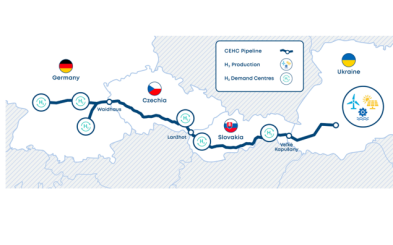
The Central European Hydrogen Corridor (CEHC) aims to create a hydrogen “highway“ in Central Europe for transporting hydrogen from major hydrogen supply areas in Ukraine to hydrogen demand clusters in Germany. The hydrogen corridor will also enable hydrogen transport between hydrogen production facilities and hydrogen consumers in the Czech Republic and Slovakia. With an initial technical capacity of 144 GWh/d, the project aims to transport green hydrogen as of 2030.
Contact: karin.stehlik@net4gas.cz
GASCADE, NET4GAS, OGE
The Czech German Hydrogen Interconnector (CGHI)
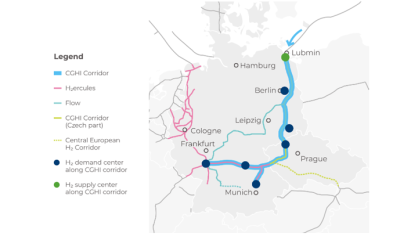
The vision of the Czech German Hydrogen Interconnector (CGHI) initiative is to create a hydrogen interconnector to connect high potential hydrogen supply areas in Northern Germany and Baltics with expected high demand clusters in the EU (predominantly in South Germany and North Bohemia). Additionally, it will also enable connection of local suppliers and consumers along the corridor.
Contact: karin.stehlik@net4gas.cz
OGE, GRTGaz, SNAM, Terega, Enagas
HyDeal
HyDeal is to enable hydrogen transport from Spain to France and, in a second step, to Germany. It aims for expansion with production in Tunisia and Italy, and transport via Italy.
Gas Connect Austria
Wind2Hydrogen Auersthal
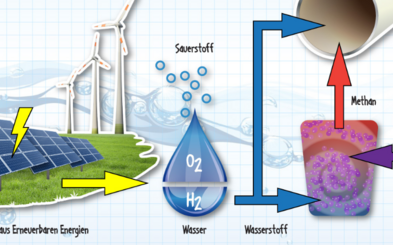
The Wind2Hydrogen pilot facility in Auersthal, Lower Austria was in operation from January 2014 until the end of 2017. It converted power from wind turbines into transportable, storable hydrogen using a new, specially developed electrolysis process that responds very quickly to changing loads from a wind farm, and can economically produce high pressure of around 165 bar.
Società Gasdotti Italia S.p.A.
HyBRIDS
Project envisages construction of a 2 km hydrogen pipeline and facilities connecting Green H2 production plant of Società Chimica Bussi (SCB) to SGI high-pressure gas network. This connection will provide:
- H2 / CH4 blending services for grid injection of excess H2 production initially up to 1% (in vol.);
- H2 modulation/ storage services allowing retrieval of H2 from pipeline, hence operating as storage infrastructure for other SCB uses.
Contact: Antonio.serlenga@sgispa.com
GRTgaz
MosaHYc (Mosel Saar HYdrogen Conversion)
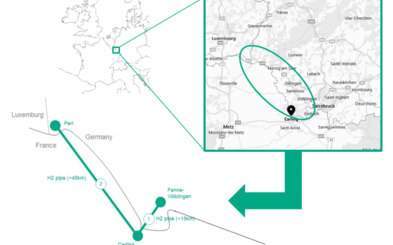
GRTgaz SA and Creos Deutschland GmbH are collaborating to create a 100% pure hydrogen infrastructure, connecting the Saar (Germany), Lorraine (France) and the Luxembourg border. This 70 km-long infrastructure will be capable of transporting up to 20,000 m³/h (60 MW) of pure hydrogen via retrofitted existing gas pipelines.
Contact: jeanmarc.brimont@grtgaz.com
GAZ-SYSTEM
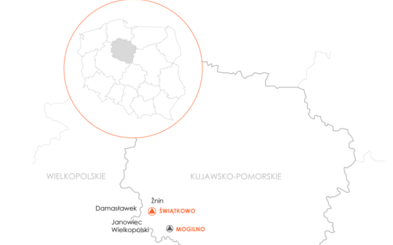
Damasławek UGS
The project calls for the first hydrogen cavern to be operational around 2030. The location and geological conditions allow for the creation of a storage facility of key importance to the energy security of Poland and the construction of the entire hydrogen economy. The storage facility can ideally fit into hydrogen clusters that will be created around industrial centers as well as offshore and renewable energy storage facilities.