INNOVATIVE PROJECTS PLATFORM

Repurposing for Renewable Gases
Repurposing of pipelines for renewable gases transport (e.g. hydrogen) is a cost effective way to meet decarbonisation goals and can be undertaken without compromising the ability of the natural gas network to ensure security of supply.
Snam, TAG GmbH, bayernets, Gas Connect Austria
SoutH2 Corridor
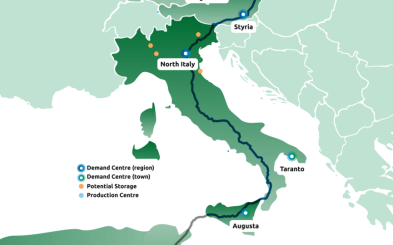
A 3,300 km dedicated hydrogen pipeline corridor connecting North Africa, Italy, Austria, and Germany, led by TSOs Snam, TAG, GCA, and bayernets. Recognized as a Project of Common Interest under the TEN-E Regulation, it aims to import over 4 Mtpa of green hydrogen from North Africa to Central Europe's largest hard-to-abate demand clusters, with roughly 65% of the route using repurposed infrastructure. Targeted to be in operation in the early 2030s.
Contacts: commercialservices@taggmbh.at, sales@gasconnect.at,
info@bayernets.de, or south2corridor@snam.it
bayernets
HyPipe One - Bavaria Hydrogen Network
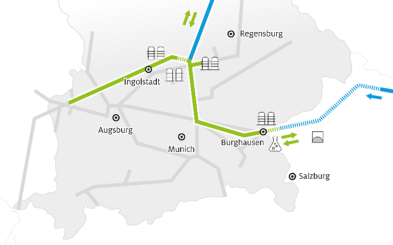
HyPipe Bavaria Hydrogen Backbone aims to establish the core hydrogen infrastructure required to connect Bavaria to the European hydrogen market by 2030. The project is recognised as a Project of Common Interest (PCI) and forms part of the European Hydrogen Backbone initiative. Through the repurposing of existing gas infrastructure and the development of new hydrogen assets, it will connect hydrogen demand centres in Bavaria with production regions in Germany and abroad, enabling hydrogen imports, supporting industrial decarbonisation, and strengthening security of supply.
Contact: Simona Rens (simona.rens@bayernets.de)
NaTran, Creos Deutschland, Creos Luxembourg
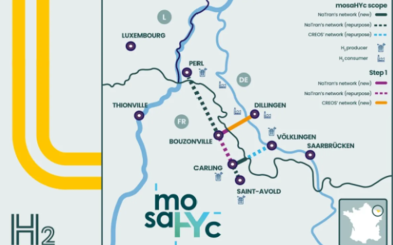
MosaHYc
mosaHYc (Moselle-Saar Hydrogen Conversion) is one of Europe’s first cross-border hydrogen infrastructure projects based on the repurposing of existing natural gas assets. The project will convert around 94 km of pipeline between France and Germany into an open hydrogen transport network, connecting industrial consumers with future hydrogen production facilities. By reusing existing infrastructure, mosaHYc supports a cost-efficient and resource-efficient transition to hydrogen and is expected to avoid approximately 0.7 million tonnes of CO₂-equivalent emissions per year in key industrial sectors, notably the steel industry.
Contact: blg-grt-mosahyc@natrangroupe.com
Transitgas AG, SWISSGAS AG, FluxSwiss Sagl, Ganeos AG
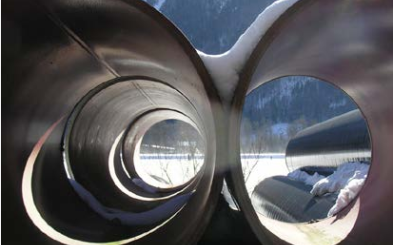
SWISS Gas NETWORKs - CH42 Initiative
CH42 Network Transformation Plan for Renewable Gases brings together 25 Swiss gas network operators to coordinate the transition of the country’s gas infrastructure towards renewable gases by 2050. The initiative covers around 50% of Switzerland’s distribution network, 98% of its transmission network and 60% of national gas consumption. Initial assessments show that 77% of analysed distribution pipelines are already hydrogen-compatible, supporting the future integration of biomethane, renewable hydrogen and synthetic methane.
Contact: vsg@gazenergie.ch
Fluxys, OGE
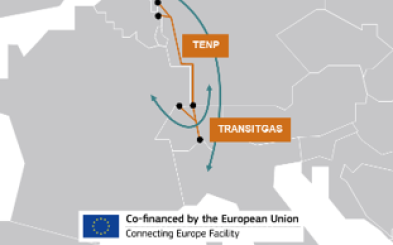
TENP III Pipeline
TENP III aims to strengthen security of supply in Germany and Europe through the modernisation of the Trans-Europe Natural Gas Pipeline connecting Northwest Europe with Switzerland and the Italian gas market. Developed by Open Grid Europe (OGE) and Fluxys TENP, the 110 km pipeline increases transport flexibility through bidirectional flows and is fully hydrogen-ready. The project supports future hydrogen imports from Southern Europe while ensuring reliable energy transport and reinforcing cross-border connectivity.
Contact: Isabelle Wippich (Isabelle.Wippich@oge.net)
FLUXYS
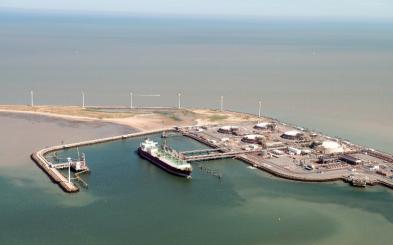
Zeebrugge Multi-molecule Hub
Zeebrugge Multi-molecule Hub aims to transform the Zeebrugge terminal into a multi-directional hub for natural gas, biomethane, hydrogen, ammonia and CO₂. Developed by Fluxys, the project will provide integrated import, export, transmission and terminalling services, supporting large-scale decarbonisation across Northwest Europe. Leveraging Zeebrugge’s strategic port location and extensive energy infrastructure, the hub will facilitate low-carbon hydrogen imports, CO₂ exports for permanent storage, and continued security of supply through diversified molecule flows.
DESFA S.A.
SmartSwitch project
H2 injection impacts major gas parameters, including pipeline pressure drop, flowrate, velocity, and most importantly, composition, GCV and Wobbe index, therefore prior to H2 addition to the grid, the installation has to achieve that the resulting blend will satisfy gas parameters. The above will be controlled by a smart hydrogen injection and operation system, which will keep hydrogen percentages at certain levels, while also deblending solutions will be applied for consumers with special needs in fuel purity.

eustream, a.s.
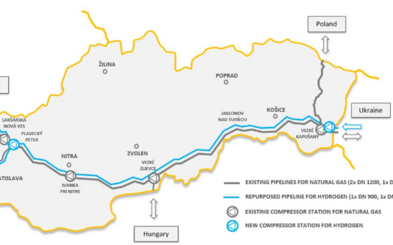
Adjustment of existing eus pipeline SK-HU
Adjustment of the line of the transmission system for transmission of 100% H2 between Slovakia and Hungary will create possibility for H2 transmisson in the North -South direction. Project is part of the Slovak Hydrogen Backbone and the SEEHyCorridor inititative. Eustream has been conducting informal market survey. Close discussions with potential H2 producers and offtakers have resulted in conclusion of several Letters of Support or Memorandum of Understanding confirming their support to and interest in the Project implementation.
PLINACRO Ltd.
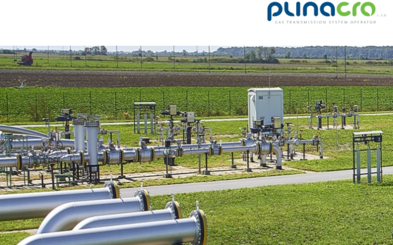
Gas system retrofitting for 100% H2 future capability
Planning and reconstruction of gas nodes, safety and metering equipment for receiving and adding decarbonized gases into the gas transmission system will begin. This includes the development of a "smart gas network" which includes advanced digital systems and components, control systems, sensor technologies, gas flow and quality management devices (compressors, gas flow control sets, reconstruction and chromatographic equipment, etc.), as to enable interactive and intelligent monitoring, measuring, quality control and management of receiving and transmission of decarbonized gases - implementation deadline in the next 10-15 years.
Contact: PLINACRO
REN
H2RENGRID - Transport Network
The project is intended to develop the necessary repurposing of the national transmission network (RNTG) for blending of hydrogen into the natural gas streams. According to the current national legislation and regulation, the network has to be able to receive gas mixtures of hydrogen and natural gas with hydrogen content of 10% v/v until 2030. For the national transmission network (RNTG), the investments are split into pipelines and inspection programs, control systems, AGI (above ground installations) equipment and analysers and metering equipment.
Contact: Pedro.Morais@rengasodutos.pt